
The Big Heat Pump Question
There is a lot of information going around about these air source and ground source heat pumps. I’m hoping to hone in on the finer point of these systems and help you on your journey to deciding whether or not they are right for you!
What are they?
Air Source and ground source heat pumps effectively do the same thing, but take their heat source from a different location. As the names suggest, air source heat pumps extract the heat from the air and ground source heat pumps extract the heat from, well, the ground! This heat can then be used by our central heating and/or hot water system.
What they do with the energy once extracted is much the same thing, so if you’re looking into one of these, the main factors will probably be space, cost and efficiency (i.e. how much heat you’re going to be able to get from the system and the rough payback).
How do they work?
Essentially, they both extract the heat from their source, pass this through a refrigerant (similar to what you have in your fridge and freezer), the refrigerant is then compressed to increase its temperature and this heat is then transferred to our heating and/or hot water system.

Conventional Air source heat pump setup

Conventional Ground source heat pump setup
Is one better than the other?
This all depends on your circumstances really. Air source, as the name suggests, extracts heat from the air. It can extract heat from the air from as low as -15, however if you live in an area that has generally very low winter temperatures, you’re unlikely to be getting the efficiency you need from it for it to be effective, and you mayneed to top it up with a conventional gas or oil heating system. In this case, you may be better off with a ground source heat pump instead.
That brings me on to ground source heat pumps. The ground tends to keep a more constant temperature throughout the year, with much milder fluctuations in temperature than the air. In colder parts of the country therefore, these are probably going to be a better option, as let’s face it, the majority of your demand will be for heating during the colder months. The chart below takes data from my home town in Cardiff UK, and shows the temperature of the ground being considerably higher than the temperature of the air during those colder Winter and Autumn months.
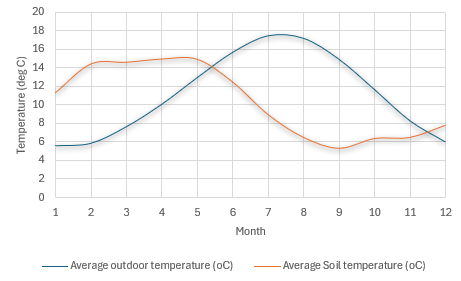
You will probably see a downside in the summer if you are using it to heat your water, compared to air source heat pumps, but I suggest the upside in the winter will more than compensate for this.
The other consideration for ground source heat pumps is the availability of space to install the pipework. There are a couple of different options when it comes to installation. You can either have a borehole, which is effectively a vertical shaft drilled into the ground in order to capture more geothermal heat. The other options is to have a trench excavated for the pipework. It is commonplace for either a specific area of your garden or a ring main around your garden to be excavated to install the pipework.
Would they work in my house?
They would work in any property, however it’s worth considering that they generally operate at lower temperatures than conventional gas boilers, at around 45oC as opposed to around 60oC, so you may find that you need to run them for longer to achieve the same warming effect, particularly if you have an older property which is not as well insulated.
How much will they cost?
This really all depends on your location and air temperature. The warmer the ambient temperature, the more efficient they are. If you are pretty rural and winter temperatures head well into the minus figures, they won’t be as efficient as if you’re living in an inner-city location, with higher comparable air temperatures (see above for ground source heat pumps).
NOTE: from my research, there is not much of a difference in savings achieved over the year between an air source and ground source heat pump, based on average air and ground temperatures in my home city of Cardiff, UK. With an average winter air temperature of 7.46oC and an average winter ground temperature of 10.14oC. In my opinion, I would only really look into ground source heat pumps as an option if either you can achieve a higher ambient ground temperature and / or average winter air temperature is less than say 4oC.
There is a factor called the Coefficient of Performance (COP), which measures the efficiency of an air or ground source heat pump. This will vary throughout the year. If for example you see a COP published for these units of say 3, this means that for every 1KWh of electricity used to power your heat pump, it will generate the equivalent of 3KWh (therefore 3 times more efficient than a conventional gas boiler).
The table below shows what sort of COP you would be likely to achieve. This is based on outdoor temperatures, but is comparable for ground temperatures too:

On average, the cost of installation is around £13,000 for air source heat pump set up and £28,000 for ground source heat pump set up. There are government grants currently available that could save you a considerable amount of money (see below).
How much money will they save me and are there any grants available?
The amount of money you can save all depends on your current set up and how efficient this is.
According to EDF, the cost of a comparable 12,000KWh (average 3 bed house) usage would be :
New Gas boiler £788.00
Older gas boiler £1,036.00
Oil fuelled boiler £1,043.00
LPG fueled boiler £1,044.00
Air source HP £980.00
This is based on current rates for gas (at around 6.04p/KWh) and electricity (at around 24.5p/KWh), which are liable to vary with time as the Government tries to incentivise the use of these products. It will only take a small shift in the prices of electricity and gas (i.e gas getting more expensive and electricity getting slightly cheaper for these savings to become much more significant and this is likely the way things will go as the Government tries to reduce the number of gas boilers being used.
You may be qualify for a Government grant £7,500 or £9,000 for some rural areas of Scotland
Will I still need to use another fuel source?
In theory, no! However, your home will need to be well insulated if you are to get the best out of the system. New homes, this shouldn’t be an issue, however if you have an aged property, this could be a little more difficult to achieve.
Given that ASHP’s have limitations on the temperatures they can achieve as compared to our older fossil fuelled alternatives, the amount of heat they can pump into our homes will therefore also be limited.
I would suggest that you do a proper review of you house insulation first. To be honest this is a good thing to do anyway, even if you’re running a conventional system. We lose so much heat through our roofs, walls and floors, that we could make significant savings by just doing this alone. Infact, I feel another blog coming along just focussing on this……
Consensus then, if you have a properly insulated home then I suggest you don’t need another heat source. I your home isn’t very well insulated, then I would suggest spending your hard earned cash focussing on this first!
Can they heat my water?
Short answer, yes! There are a couple of different types of ASHP. Air to Air, which as the name suggests, heats the air in your home via strategically placed vents. Air to Water uses the heat generated with the ASHP to heat your water (that supplies both your heating and hot water)